


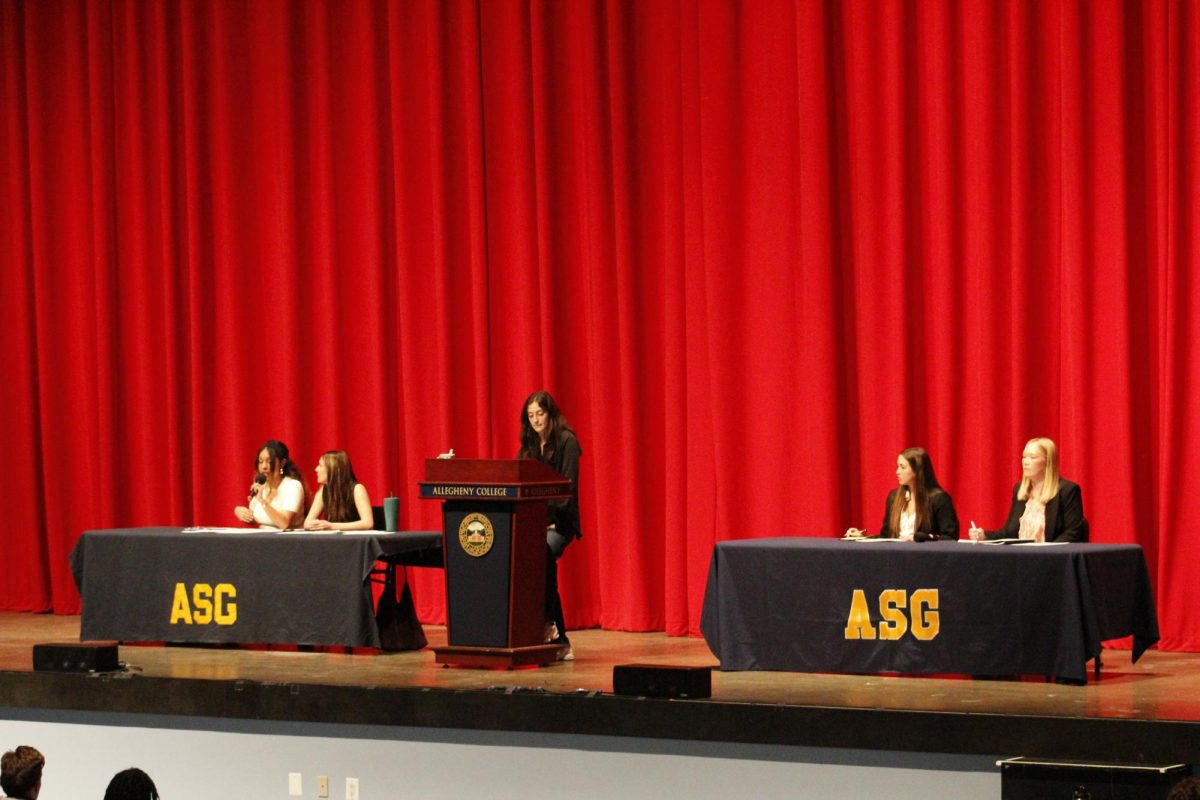
While a tornado watch was in effect for Meadville, the mood at the annual Allegheny Student Government presidential debate was similarly stormy, with discussion between the two tickets leading to biting remarks on stage and prompting several audience outbursts that caused the ASG faculty advisor to rise out of their seat at least once.
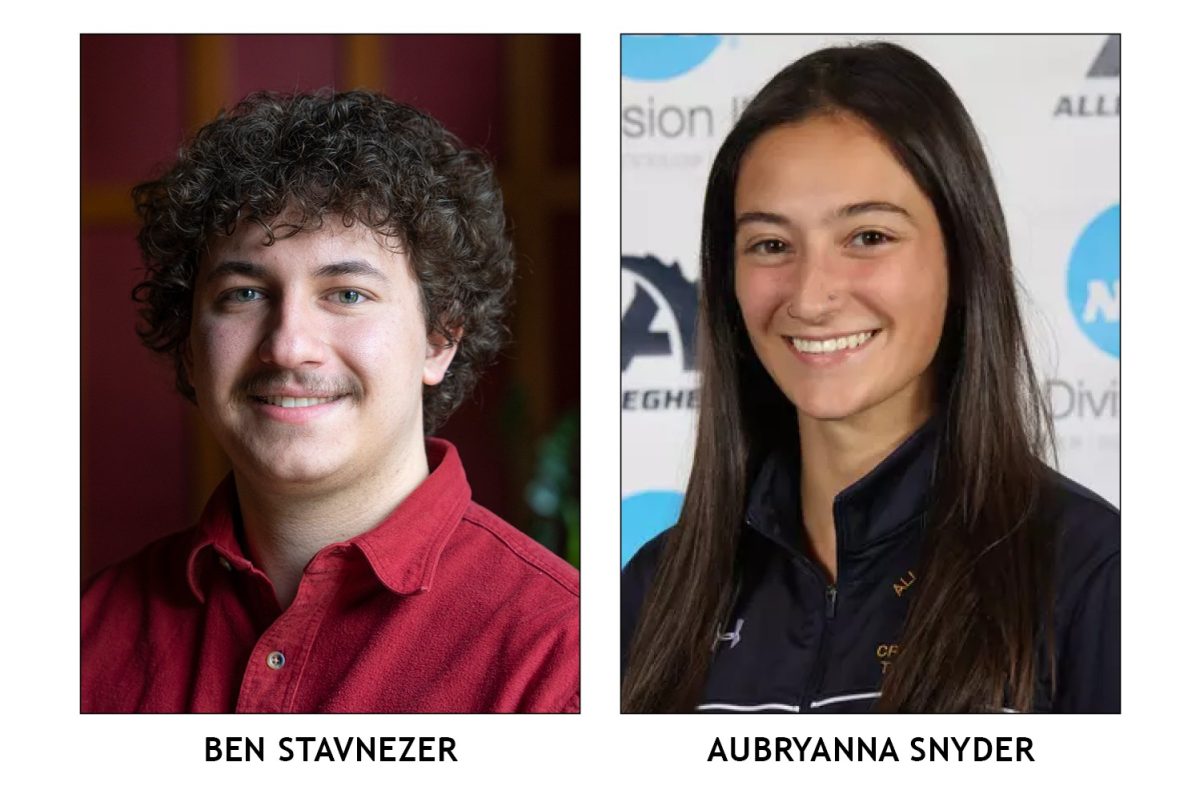
The discussion between presidential candidate Aubrey Carion, ’27, and her running mate Amberlyn Escobar, ’27, and presidential candidate Ella DeRose, ’27, and her running mate Kylie Thompson, ’27, took place in the Shafer Auditorium on Tuesday, March 26. The debate was moderated by Aubryanna Snyder, ’27, who serves as news editor for The Campus.
Over 150 people filled the seats of the auditorium, with the Instagram livestream garnering an additional 116 views, according to ASG Director of Communication and Press Jake Slater, ’26. More than 35 audience questions were collected on notecards over the course of the hour-long debate.
Both candidates delivered opening statements to begin the debate.
Thompson introduced her ticket by focusing on a central aspect of her and DeRose’s campaign: experience.
“Our ticket brings a unique combination of experience and perspective to student leadership,” Thompson said. “Our slogan, ‘grounded by community, prepared by experience and committed to progress,’ reflects these guiding principles.”
Thompson reminded the audience that DeRose had already served as ASG president during the 2024-25 academic year and said that she and DeRose were motivated to run for the positions due to their love for the Allegheny and Meadville communities.
“Tonight we’d like to remind you that in voting for ASG executives, you are not choosing someone to speak for you,” Thompson said. “You are placing your trust in the people that will work with you and respect the wide variety of experiences, identities and values that make our community worth preserving.”
Carion and Escobar both spoke in their opening statement, with Carion highlighting that she was motivated to run for president, in part, because of the difficulties she faced finding community in the past.
“I want every student to have that same opportunity to connect, belong and thrive,” Carion said before introducing the campaign’s three core pillars: one team, one campus; community without walls; and bridge to the city.
While Carion emphasized her three years of experience in ASG, including as the current director of community relations, she also dedicated significant time to discussing her non-ASG experiences.
“Over the past few years, I’ve had the privilege of serving our campus and the Meadville community in many ways — from organizing food distribution at the YMCA, creating art programing for children at the Liberty House, volunteering with the Meadville Free Clinic, to mentoring students at the Meadville Area High School,” Carion said. “These experiences have shaped my understanding of leadership, service and the importance of building strong, supportive communities.”
Escobar additionally emphasized her role as president of the Black Student Union and her other engagement with Meadville-focused community projects.
One theme that recurred across the whole debate was access to resources and getting students involved with events on campus.
DeRose said the topic was a core factor she and Thompson considered when developing their campaign platform.
“The real idea behind all of it was creating lower commitment ways for students to get involved,” DeRose said.
The DeRose/Thompson ticket highlighted ideas in their campaign platform designed to foster coordination and efficiency among existing organizations and resources, such as a coordination committee for student organizations and improvements to the ASG finance system.
“Creating opportunities to serve our community on campus, bringing community partners to campus and helping connect students with organizations that already exist is a much better use of our time and our resources,” DeRose said.
In her response, Carion said a key difference between the two campaigns in this realm was the viability and specificity of each ticket’s ideas, before going on to highlight her hope to establish a marching band and an inter-community council. Carion added that she and Escobar had already met with several individuals who would be key to executing their campaign initiatives.
“Amber and I don’t just talk about ideas,” Carion said. “We bring action and a plan to make them happen.”
Sparks began to fly during the second question of the evening, when candidates were asked how their term would differ from previous ASG terms.
The Carion/Escobar ticket went on the offensive, discussing DeRose’s presidency last year.
“We want to speak a little bit about our opponent’s previous presidency,” Escobar said. “We acknowledge, obviously, that experience is important. However, in our opponent’s last presidency, they did not make a single project that had a lasting impact on campus.”
Carion added specific statistics which she said bolstered Escobar’s claim.
“Under Ella’s first presidency, at the very first General Assembly of the year she did not have a vice president, she was missing a director of finance and one other member of the cabinet,” Carion said. “At the end of the first semester, three cabinet positions were not filled and four out of 20 senate seats were vacant. By the end of Ella’s first term, there was not a single General Assembly that had a full senate. Out of 25 general assemblies, the cabinet changed seven times; 72% of Ella’s prior candidacy had inconsistent cabinet members. To put this into perspective, the cabinet has changed not once this year. These statistics are imperative, as they show the true experience that they are capitalizing on.”
DeRose called the other ticket’s statements “slightly disrespectful” and countered their claims by naming the projects she completed, such as being a part of the conversations to install outdoor Wi-Fi and build the outdoor classroom by the Lawrence Lee Pelletier Library, installing a light outside Crawford Hall to improve student safety and restarting college committees that she said invited more non-ASG students into conversations about the college.
DeRose also said that in the future she would not have the same number of vacant positions on her cabinet that she had during her first presidential term.
“Something I prioritized really going into that term — remember, I was a sophomore starting out in ASG as president — was prioritizing people who were quality leaders that could commit to it and were able to take on that responsibility,” DeRose said. “Obviously that’s an issue we’ve seen, and it’s something that I’d like to solve going into next year. Finding people who are really able to make that commitment, and not only that, but people who are willing to take it on because they care, not just because they want a leadership position or a mark on their resume that makes them look good.”
Another recurring topic during the debate involved the candidates’ plans for Allegheny-Meadville relations.
In response to an audience question about how each ticket would increase inclusivity and foster a sense of belonging for students, the Carion/Escobar ticket said that the college’s relationship with Meadville is an important part of students feeling comfortable on campus.
“I think that fostering a sense of belonging at Allegheny really starts from students feeling like they belong in Meadville,” Escobar said. “I mentioned previously, coming into college felt like a culture shock, and I think that with our pillar ‘bridge to the city,’ making students feel more welcome in Meadville — if they involve themselves downtown, if they’re going to things downtown — they will then in turn feel more welcome at Allegheny because we are a part of Meadville as well.”
In her response, DeRose sought to distinguish her ticket’s approach.
“One thing I’d just like to add that I think I might have missed in the ‘differences about the tickets (question)’ is just that we’re really trying to bring community partners to campus,” DeRose said. “Highlighting that aspect of accessibility, if a student doesn’t have a car, they physically cannot go down into Meadville to meet partners and have that same experience in belonging. We want to bring that experience to campus and make it easier for students, during the day, on campus, to have those experiences, to make those connections, to build that sense of belonging, and I think that’s something that sets us apart.”
The debate ended with closing statements from each candidate affirming the values and goals each ticket sees as critical to their platforms.
The Carion/Escobar ticket spoke first, emphasizing their core campaign slogan.
“Our mission for student government is clear: to bridge the gaps between communities on this campus, so that every student feels valued,” Carion said. “Because when a campus is divided, some students struggle in silence, but when a campus is united, every student has a chance to succeed. Amber and I bring different perspectives — perspectives that allow us to work together and accomplish our goals. We are prepared, we are experienced and, above all, we are the most determined, most tenacious and most passionate team ready to build a campus where every voice matters, every community is respected and every student truly belongs. Together, we don’t just imagine a better campus — we make it a reality. Together, we bridge the gaps.”
The DeRose/Thompson ticket followed.
“A large part of my college journey at Allegheny has been defined by service to others, and I was lucky enough to find that space of service and passion within ASG,” DeRose said. “I want to emphasize I’m not here to just do it again for a resume booster. Really, I’m here because I feel a duty to give back to this community, as does Kylie. Allegheny has allowed us to grow, and for that we want to use our skills, our experience and our dedication and our love for this college to contribute to the vitality of this community.”
DeRose also talked about her leadership philosophy, saying that leadership is an “unwavering obligation not to power, but to compassion and respect for others.”
“During these last few weeks of campaigning, however, we’ve come face-to-face with some of the harsher parts of leadership,” DeRose said. “There’s the saying ‘Any PR is good PR,’ but let me tell you that’s not true. Hate and division are not a part of competition. It’s not an indicator of capability.”
Voting opened immediately after the debate and will remain open until Thursday, April 2, at 9 p.m. The voting form is available on the ASG Instagram account, on GatorHub and on flyers hung in the Henderson Campus Center. More information about the tickets’ campaign platforms can be found on The Campus’ website. Seniors are not eligible to vote.



Al Coppolo • Mar 28, 2026 at 6:12 am
As a graduate of the Class of ’78, let me ask a question, “has somehow the distance between the college and downtown Meadville changed in the past 50 years?”. I recall frequent walks downtown, sometimes multiple times a day, even in the snow – both directions. I don’t understand why transportation is necessary unless it’s a visit to Walmart or one of the surrounding communities. Please help me understand.
Ella DeRose • Mar 31, 2026 at 4:43 pm
Hi Al, thanks for the question. I’m happy to weigh in here. While transportation is a large conversation in our community, the question myself and my running mate are attempting to answer is how to bring Meadville to the College. With the number of student athletes, commuter students from Meadville and surrounding areas, and heavily involved student leaders, we are prioritizing accessibility of opportunity and information. It is completely possible to utilize CATA public transit for many things. In some cases, however, opportunities are missed when students cannot even begin to find time for community involvement. Kylie Thompson and I have been discussing ways to bring resources here during the school day, when students are able to build these connections with community involvement. To us, the distance between Meadville and Allegheny is not just one of physical proximity, but also one of ease. Throughout the discussions at the debate and in our campaign, we’ve alluded to the importance of “low commitment” opportunities that increase the likelihood of meaningful connections between Meadville leaders, businesses, and organizations with students. This includes small ways to serve and connect because we believe that large impacts stem from easy access to opportunities. I hope this provides some clarity and I appreciate you staying involved as an alumni. Hope to see you at Reunion!
Al Coppolo • Apr 4, 2026 at 8:59 am
I think public statements are an important record. In an environment where the truth can no longer be taken for granted, hyperbole can be misinterpreted as facts. The simple statement that “Highlighting that aspect of accessibility, if a student doesn’t have a car, they physically cannot go down into Meadville to meet partners and have that same experience in belonging.” This is at least an exaggeration and more realistically an inaccuracy. Left standing, it justifies an inaccurate excuse for students not venturing off campus to further engage and enjoy what the Meadville community has to offer. Quite simply, the downtown of Meadville is very accessible by foot from the Allegheny campus and visa versa. Students should not be given the justification that a lack of advantage in this area is related to distance or accessibility of a vehicle. That is simply an inaccurate explanation. If you are working to overcome physical distance, you’re focusing on the wrong problem.