From feeding kangaroos to a road trip to a non-tourist Spanish beach, each semester students return to Allegheny transformed by a semester abroad rich in memorable experiences and intense cultural immersion.
Skye Kramer, ’27, went abroad in fall 2025 to Australia.
As an environmental science major, Kramer considered either Costa Rica or Australia as destinations for her semester abroad, but due to the uniqueness of traveling to the South Pacific, she picked Australia.
“I think my favorite memory — there’s so many — but the one that kind of speaks out to me whenever I get asked this question is going to the Australia zoo and feeding the kangaroos,” Kramer said. “It was just being able to do that and be that up close with these animals because people are like, ‘Little kangaroos, they’re like the mean ones, they’re the ones that are going to fight you.’ But being able to just go up to them and feed them, they would hold your hand and it was just the cutest thing ever.”
Kramer was in awe and cried happy tears during the experience, describing the moment as breathtaking.
Kramer said one of the biggest cultural shocks was the hot weather.
“The climate was kind of a big one because here it’s currently negative whatever degrees outside, that I don’t want to think about, to then going to the 90 degrees temperatures that I had every day that I was there, because I was in their spring semester,” Kramer said. “So just kind of understanding that like, ‘Hey, once you go back it’s going to be cold again and so might as well enjoy the sun, get the tan, enjoy life in the summer — or in the Australian summer,’ I feel that was kind of the biggest switch for me.”
Another personal shock for Kramer was the dynamic of transitioning from being a student-athlete to then traveling abroad and not having to play a sport for a while.
“The amount of free time that I had over there, too, was just not typical for me,” said Kramer, who is a member of the track team. “Being a student-athlete here and then going to only having classes, it was like, ‘What am I supposed to do with myself?’ So then I ended up traveling a lot more.”
That free time helped Kramer to connect with the country and its people. Living in her program’s international house, Kramer thought all of her fellow roommates would also be studying abroad like her, but she ended up having five Australian roommates.
Those roommates didn’t just become her friends, but also helped her to pick up Australian English slang.
“It’s also still English, but they like to shortcut a few words. So instead of saying, like, sunglasses, they would say sunnies — breakfast, brekkie,” Kramer said. “So their (her roommates) favorite thing to do was quiz me on their lingo, which, I mean, I’m grateful for because now some of those words are my favorite ones to say.”
On the other hand, some students have a completely different language to learn and speak when studying abroad, like Ella DeRose, ’27, who went to Seville, Spain.
DeRose studied Spanish in high school and wanted to continue learning in college, and that helped her make the decision to go abroad to a Spanish-speaking country.
“I decided to go to Spain; I thought it would be fun,” DeRose said. “I really wanted to travel in Europe, and I loved Spain the first time I had visited. Seville, specifically, I chose because I really wanted warmer weather. I thought a smaller city would be nice; it would be a bit more of an intimate experience. I also knew that there were a lot of arts, the culture was really rich in the south and so that’s why I decided to go to Seville.”
DeRose, like other students studying away, faced challenges during her time abroad. One of those challenges was speaking Spanish.
“The other challenge for me was just going by myself,” DeRose said. “I didn’t have any other close friends with me, really. So just meeting new people and adapting to a second language and also just the independence of it all. I didn’t live with the host family, I lived in an apartment, so I was cooking for myself, shopping for myself, cleaning and doing that all in a second language.”
Those challenges paid off though. DeRose experienced some incredible moments in Seville.
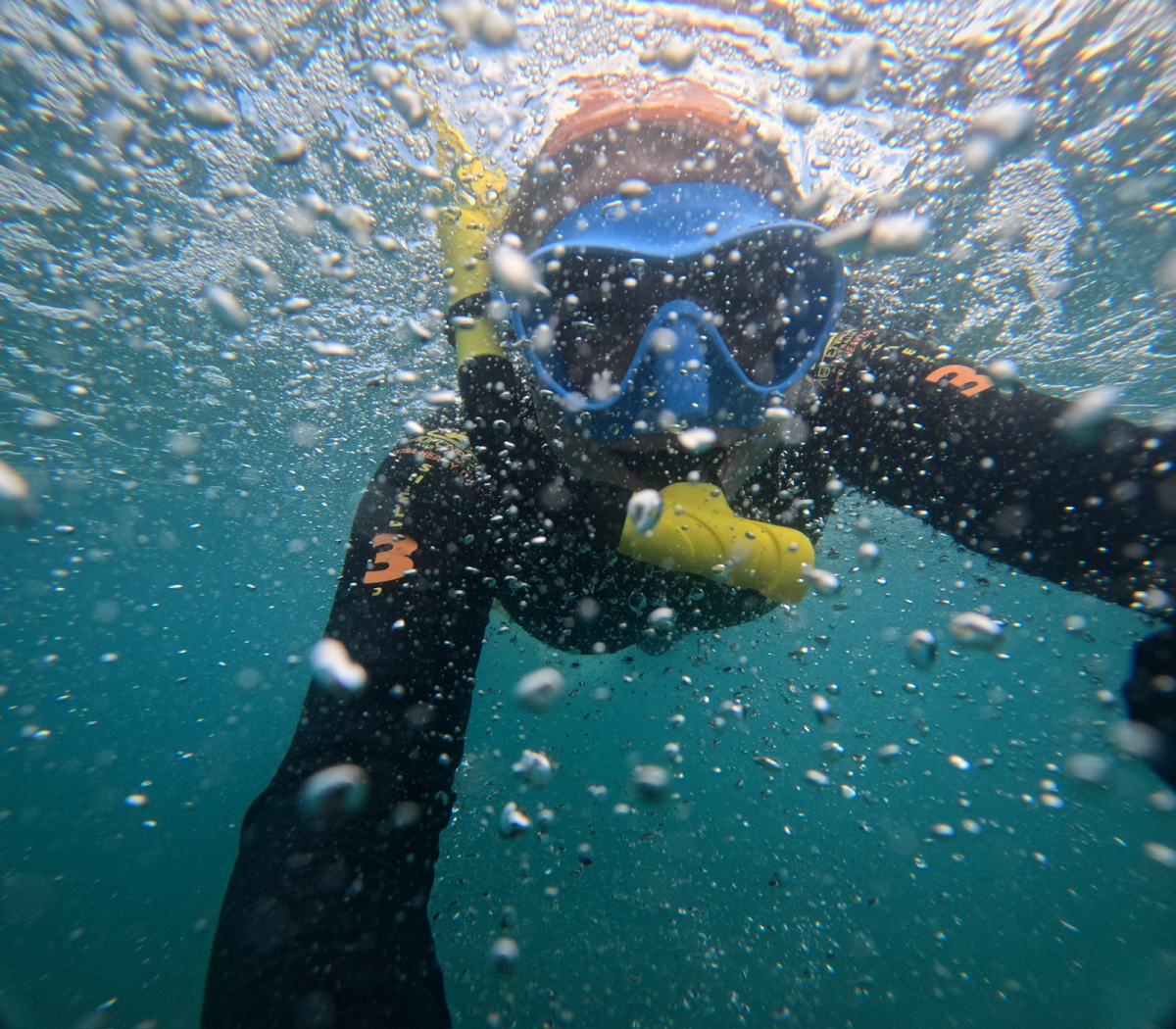
“I think one of my favorite memories, my friends and I planned a really impromptu trip to a small beach. It was not a city that I thought I would visit and there were no other tourists there. And so every time we interacted with people, they were like, ‘Why are you here? Why are you visiting? Where are you from?’” DeRose said. “It ended up being my favorite trip. It wasn’t a big city, I was really just swimming and we went cliff jumping. It was really fun. But I think just all of those little trips and moments with my friends that happened that weren’t planned, that was the best part. It was kind of scary for me. I like having a plan, but, you know, I learned to change, I guess.”
DeRose has no doubts when it comes to encouraging other students to study overseas.
“I would say definitely (do it) if you have the chance to study abroad,” DeRose said. “The entire thing, you think you can plan it and you can’t, and I think the unexpectedness of it all is where you learn the most. I’ve learned a lot and I think everyone who I know has studied away has learned a lot. I do think it kind of changes you as a person and that’s a scary thing to accept — that you’re going to change — but it’s going to happen either way. So you might as well have fun doing it somewhere else.”
Like DeRose, Lucas Bradley, ’27, is learning Spanish, so he chose to go to Argentina to expand upon what he has learned while majoring in the language, as well as his major in international studies.
Bradley was a bit nervous before going to Argentina, especially because he hadn’t spoken Spanish for over two months before his trip.
However, he loved every second of the adventure and was never bored. He described his experience as immersive and wonderful.
“This was my first time ever leaving the country, second time ever on a plane,” Bradley said. “So, it was a little nerve racking, I think, going down the 11-hour flight, it’s a little, ‘Oh, wow, it’s a really long time. I’ve only seen the entire day.’ It was my first time in the region, and I can’t wait to go back. I mean, I’m already looking at internships down there, and I talk to some of my program managers and leaders all the time about going back and volunteering with high school programs they have. It opened up a whole world of possibilities and, I mean, I love to travel now.”
Unlike Kramer and DeRose, Bradley chose to live with a host family.
Bradley lived with a host mom, a host brother, who was 28 years old, and also one of the family’s cousins. He is confident to say that his host family is what he misses the most from his semester in Argentina.
“We spent so much time together, whether it was doing puzzles, making dinner, eating dinner; definitely also that casual conversation every day,” Bradley said. “I think that is what improved my Spanish the most, not just sitting in the classroom listening — but leaving the classroom, going home, practicing, learning all these things. My host mom and I would drink a cup of tea every night together after dinner and just talk and sometimes do homework, or she would do some work she had for her job.”
Bradley also didn’t have a heavy workload, which gave him time to explore Buenos Aires.
“Most days, I was not in class for more than three hours, and so I had the entire evening and most of the entire afternoon to just explore the city,” Bradley said. “I think because a lot of the classes are designed for international students, they take that into account when assigning a workload because they know that obviously they’re (the students) in a brand new environment, they want to explore the city, explore everything the country has to offer, and so they definitely take that indirect asynchronous learning into account when assigning workloads.”
Bradley had advice for students with fears about studying abroad.
“I know a lot of students going down were very worried about their Spanish-speaking ability, but I felt everyone there was at least very happy to see that at least people that weren’t from Argentina were practicing their Spanish and trying to interact,” Bradley said. “That meant way more to people than any ability could. Everyone’s so open and so welcoming, it’s lovely. It’s not something you find here every day.”