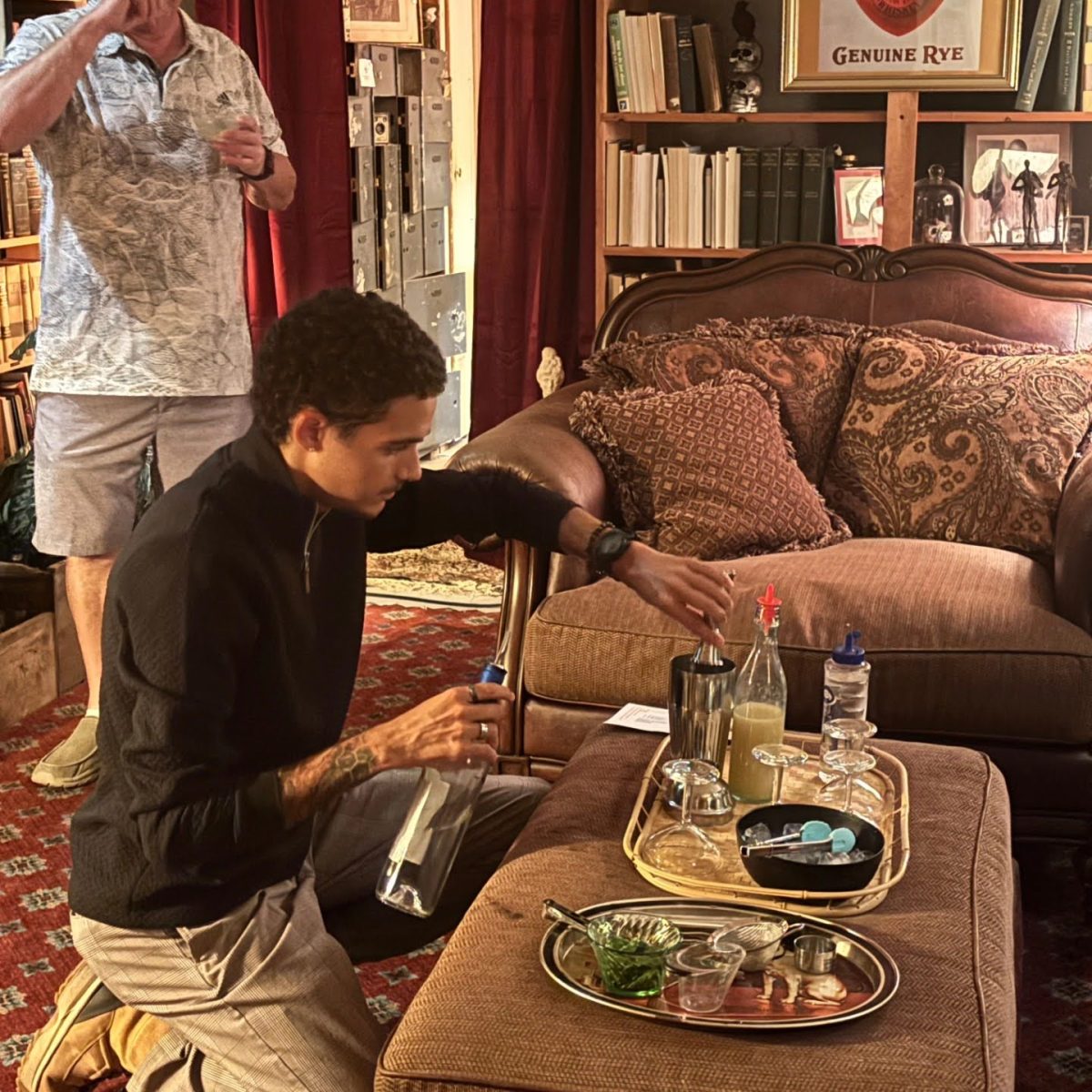
By day, Ron Mattocks is the owner of Bull Moose Marketing, a marketing agency that specializes in tourism promotion strategy and downtown economic development, where he says one of the largest recent projects in the company’s pipeline involves marketing distilled spirits made in Pennsylvania. At The Vault, a Prohibition-themed event space located inside the Crawford County Trust Building’s basement bank vault on Chestnut Street, Mattocks moonlights as the owner of Meadville Distilling and the host of cocktail classes and small gatherings that allow people to taste what social life might have been like in Meadville’s early 20th century speakeasies. There, he’s noticed a pattern that echoes the event space’s period setting: an outpouring of interest in non-alcoholic drinks among young people.
“We’ve got students coming in, we’ve got young people coming in, and (they) were asking — we’d get a few questions about” nonalcoholic options, Mattocks said, “and really all we had was, like, sodas and some juices and stuff.”
Across the country, polls show that young people have developed markedly different behaviors and attitudes towards alcohol than older generations once held at the same ages. Regular and occasional drinking among adults under 35 years has declined over the past two decades, while the perception that alcohol is bad for a person’s health has more than doubled in prevalence among the same age group over that same time period. Adults under 30 are spending less of their total income on alcohol, and more Americans reported interest in Dry January this year.
“Correlating the two, like, hey, listen, there’s obviously a demand,” Mattocks said, “and we’re seeing that here locally.”
At Allegheny, annual reports of crime statistics released under the Jeanne Clery Campus Safety Act show decreasing rates of disciplinary referrals for alcohol violations. Crime statistics aren’t representative of the actual amount or intensity of worrying student alcohol consumption since levels of enforcement can vary from year to year, but they can serve as a gauge for trends over time as well as reflect what the institution sees as its largest priorities in managing student conduct.
Thia Ferderbar, ’26, is one member of the growing group of young adults who report drinking less than once or twice a month.
“I think a big thing for me, at least as I’ve been sort of stepping away from alcohol, it’s just — it’s expensive,” Ferderbar said. “Drinks can range anywhere from like, seven to 14 bucks, depending on where you are. I was down in Pittsburgh at a pop-up bar, drinks were between $14 and $17, and I don’t really have the money for that.”
She thinks that Allegheny being a small school in a small town results in alcohol holding a much less prominent role in shaping the social lives of drinking-age students.
“I have quite a few friends who go to Penn State,” Ferderbar said. “They tell me that every weekend is blackout drunk, that people are drinking from Wednesday to Sunday, and I think because that’s just such a bigger community, there’s more opportunities, honestly.”
A less rowdy campus culture matched up with the way Ferderbar prefers to interact with alcohol.
“I realized that I’m a homebody,” she said. “If I’m going to be drinking, I’d much rather stay in and do it with friends, like watch a movie or just hang out, and that just, for me, seems more fun. Going to a party, you have to get ready, and then you’re in a cramped basement and you can’t hear anybody talk.”
Although she observed that first-years still seem drawn towards heavy drinking because they are “kind of figuring out what their limits are,” she thought that many of-age upperclassmen like herself who do go out for the night prioritize fewer drinks in the quiet, relaxed environments in the city’s bars over the higher-energy atmosphere of college parties.
“A pattern that I’ve seen a lot is that the people who are of age, they go to the frat for, like, the last 30 minutes to pre-game, and then they go to the bar, and that’s where a lot of the older, of-age people congregate,” Ferderbar said. “It’s just nice to sit down, have a drink, talk with friends, and it’s just a much more relaxed environment as far as bars go.”
Ferderbar, a member of the Kappa Alpha Theta sorority, reflected on Greek life at Allegheny in relation to the stereotypically alcohol-steeped cultural narratives that dominate media representations of college fraternities and sororities.
“One thing that I’m really grateful for is that alcohol and Greek life have been kept as two very separate things for me,” she said. “Honestly, when I ask my sisters what their weekend plans are, nine times out of 10 the answer is staying in. So we’re all very much, I think, of the same mindset too, where it’s just like, that isn’t our scene. We’ll go out maybe every once in a while.”
Mattocks has been monitoring what young adults’ shifting attitudes towards alcohol means for businesses that have traditionally depended on its sale.
“There’s just a lot of advantages to that, I think, on both sides,” he said.
Mattocks has responded by offering dedicated craft mocktails and mocktail classes at The Vault, which he said have provided greater flexibility for his business and for the customers who socialize there.
The Vault doesn’t have a full liquor license, so alcohol-free events allow Mattocks to open the space to the public more often without incurring the additional cost of obtaining an alcohol license for each event.
“To be able to do the same thing, have people there, have an experience, offer a craft mocktail and nonalcoholic options for them, and they get to take and enjoy themselves at The Vault, that’s just good for the community as well,” Mattocks said.
The trend aligns with Mattocks’ belief that there is a need for more “third spaces” in Meadville — places where people can meet up outside of their workplaces and homes to spend time with one another.
He pointed out that by placing more dedicated nonalcoholic options on the menu, venues can expand the number of people who feel comfortable taking part in the same activities as others in that space.
“We’ll get couples that come in, and one of them is driving, and they don’t want to feel that guilt or apprehension of like, ‘I can’t drink too much because I’m driving tonight,’” Mattocks said. “I know I’ve seen in the past where, before we were doing this, we didn’t have those options, so you can tell, like, that person felt left out.”
A couple of people, Mattocks recalled, “said that they came because their friends felt like they could take them there and they knew that those options existed and stuff.”
“Why keep trying to take and push stuff people don’t want?” Mattocks said. “It’s better to go, you know, ‘Hey, there’s a product, and then there’s a demand out there from a business standpoint. People have to — businesses have to — take and adapt; the industries have to take and adapt to that.”