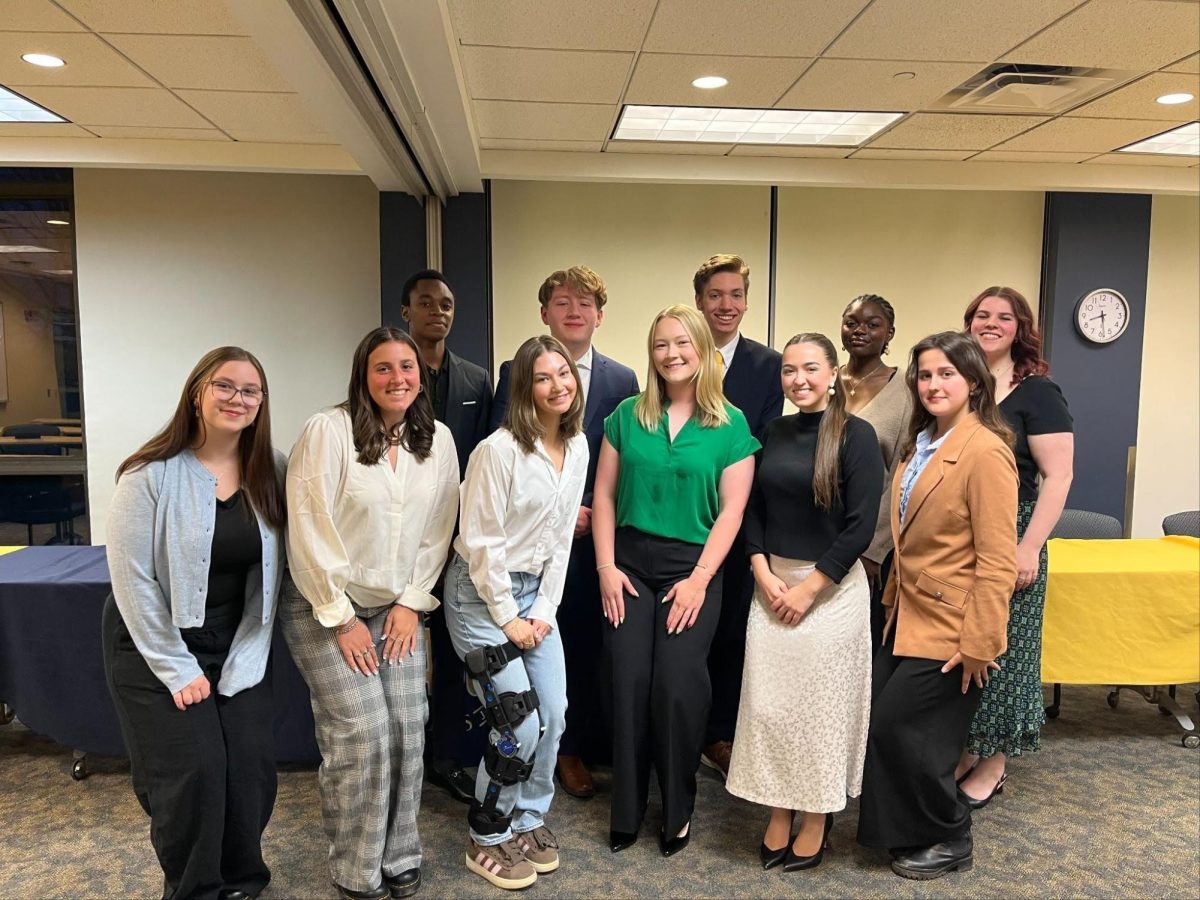

An alumni panel during Blue & Gold Weekend invited alumni who have artificial intelligence experience to share their thoughts about how AI has become prominent in their professional lives, how it is reshaping the way they approach obstacles and how it is challenging human potential within businesses.
Four graduates participated in the “Board of Visitors Roundtable: From Classroom to Boardroom — Embracing AI’s Impact” in the Henderson Auditorium in Quigley Hall on Friday, Sept. 19. Hemani Alaparthi, ’27, who is double-majoring in computer science and economics, introduced the panel members: Angelica Runova, ’06, a senior strategy and planning manager at PNC Bank; Dayan Abeyaratne, ’94, a partner with PJT Partners Inc; Morgan Dukman, ’23, who works in information security and AI at BNY; and Lauren Odrechowski, ’10, who works in communications and AI at BNY.
Assistant Professor of Business & Economics and International Studies Chris Finaret moderated the event. One of the first questions he posed to the panel was, “Where do you see AI the most in your workplace, and how are you adapting to it?”
Runova began the discussion by describing AI as being “at the forefront of the nation’s industries” and noting its prominence in driving investments and business utilization. PNC, Runova said, has found an abundance of partnerships with organizations using AI to create a “small streamliner of internal workflows.”
“It allows all of us to have an internal ChatGPT,” Runova said, describing PNC’s streamliner tool.
Odrechowski, in response to Runova, referenced BNY’s recent $12 million investment to install an AI lab at Carnegie Mellon University to “drive investments in AI, making sure that we’re being responsible.” Dukman further elaborated on this by mentioning how much “time, money and resources” BNY has put into AI, as well as the improvements they’ve seen time-wise.
“Applications that took them three days now take them three hours,” Dukman said.
Abeyaratne joined the panel’s discussion by calling out the differences between PJT and BNY. PJT, Abeyaratne said, is “highly people-oriented with a lot of analytics, number crunching and it is very people-centric.” PJT, in contrast, is spending money on AI and educating its workforce to use AI, but has not yet adopted it.
“PJT has yet to embrace AI for a multitude of reasons,” Abeyaratne said. “Firstly, due to a confidentiality standpoint, as entering their files into an online database could be a risk if any of those files were to get out. The second reason ties back into how people-centric PJT is in the manner that they don’t ever plan on replacing that human element of number crunching and analytics, even within the most junior levels of their organization.”
Abeyaratne made it clear that AI cannot displace some workers.
“We will always still need people who can look and process and read through things analytically,” Abeyaratne said. “You can have AI run an analysis for you, but you’ll still need people who can process it all.”
Finaret led the discussion into a tier-based ranking system to demonstrate how AI can be useful in some fields, but is also not the most sought-after quality in job candidates. Finaret pulled eight answers from a World Economics Form survey from potential employers about what qualities stand out in interview candidates. He then asked the panel members to rank each quality into the tier they think that quality best fits in.
The panel decided that the qualities of analytical thinking, AI and big data and empathy and listening deserved the highest tier, while creative thinking, teaching/mentoring and dexterity endurance landed in the second highest tier. Resource management and environmental stewardship were placed in the third tier, and multilingualism was sorted into the lowest tier.
Once the rankings were agreed on, the panelists explained their reasoning for these rankings. Dukman said that analytic thinking is extremely important to employers because they look for “the ability to analyze numbers as well as strategic thinking and processes.” One member of the crowd joined the conversation by asking if the panel didn’t think “multilingualism was important to expanding companies overseas.”
Abeyaratne took the floor for this question, clarifying that, during his first five years of being in the workforce, from 1995 to 2000, the internet was in its infancy, and most companies still used translators when having discussions with representatives from foreign countries. Human translators were essential, Abeyaratne said, recalling that “it was hard to understand the culture past the language” without them.
Runova added a personal anecdote, saying that she and her son had grown up bilingual, but her spouse did not, so he would rely on interpretation apps to understand them. She used this to illustrate the point that the AI translation was often incorrect, versus someone who has studied the language and can accurately translate the conversations.
The final portion of the discussion was open to the crowd. An audience member proposed the idea that in the future, there may be a significant divide between businesses that refuse to use AI and businesses that heavily embrace AI, and asked for the panel’s opinions on that topic. Odrechowski spoke first and explained how AI usage within a company would rely heavily on the types of human interactions an employee would be having.
“Someone working in an office building would have a lot more opportunities and tasks that involve AI than anyone in the medical field, which requires training and mentoring,” Odrechowski said.
The final discussion topic for the panel, asked by audience member Robyn Stojakovich, ’09, a recruiter for Idaho National Laboratory, was, “How likely is it that AI will continue to displace people from their jobs?”
Dukman took the opportunity to highlight the fact that AI has integrated into a small number of jobs but has also opened up the floor for new jobs that didn’t exist before.
“There will still be jobs,” Dukman said, “requiring someone to check AI’s work.”