
Kicking off a diverse slate of programming to honor the 150th anniversary of The Campus, a virtual panel titled “Voices of The Campus: A Legacy of Student Journalism at Allegheny,” took place on Tuesday, Jan. 13.
The event focused on the different stories The Campus has covered throughout the years, with the panel consisting of five former editors-in-chief ranging from the 1960s to the 2020s. Anna Westbrook, ’26, the current editor-in-chief, moderated the event.
“For 150 years there’s this unbroken chain that binds everyone on this call,” said Cody Switzer, ’07, during the panel. “For 150 years we’ve been afforded this opportunity to do something for a community we care deeply about.”
The editors-in-chief each described the stories that most influenced their time at the paper, ranging from the Vietnam War to the COVID-19 pandemic.
Kathé Tunnell Cairns, ’66, described the newspaper’s role in organizing a “lecture-in” that involved Congressman Richard Schweiker and then Lieutenant Governor Raymond P. Shafer, ’38.
“For some reason, we decided to jump in,” said Cairns, on covering the Vietnam War. “We sort of stepped out of our role as a newspaper and were a little bit of news making.”
Roman Hladio, ’23, described his time with the paper during the pandemic, which partially coincided with the Black Lives Matter movement.
“We were just trying to get by,” Hladio said. “You’re trying to work and do your school work and you’re watching protests around the country and on campus as well. Everyone was uneasy all the time.”
Pat Bywater, ’89, was a member of The Campus during the growing anti-apartheid movement, which brought protests and divestment calls to Allegheny.
“Both the faculty and student community latched on to that and was really pushing the board of trustees to disinvest,” Bywater said. “We felt our role was to try to represent all the sides, but also do some education.”
Switzer was on the newspaper staff during a change in technological capabilities, with the early arrival of social media and the importance of an online presence beginning to appear.
“One of the things that’s kind of remarkable about that time is how little we thought about publishing online,” Switzer said. “We were drunk with the power of Photoshop QuarkXPress.”
Switzer said that Facebook began at Allegheny his sophomore year and significantly changed his life as a reporter. “Suddenly, as a reporter it’s great, because suddenly everything is documented publicly,” Switzer said. “It was really easy to find sources.”
Westbrook asked the panel to reflect on the importance of The Campus and what the panelists hope to see from the newspaper in the future.
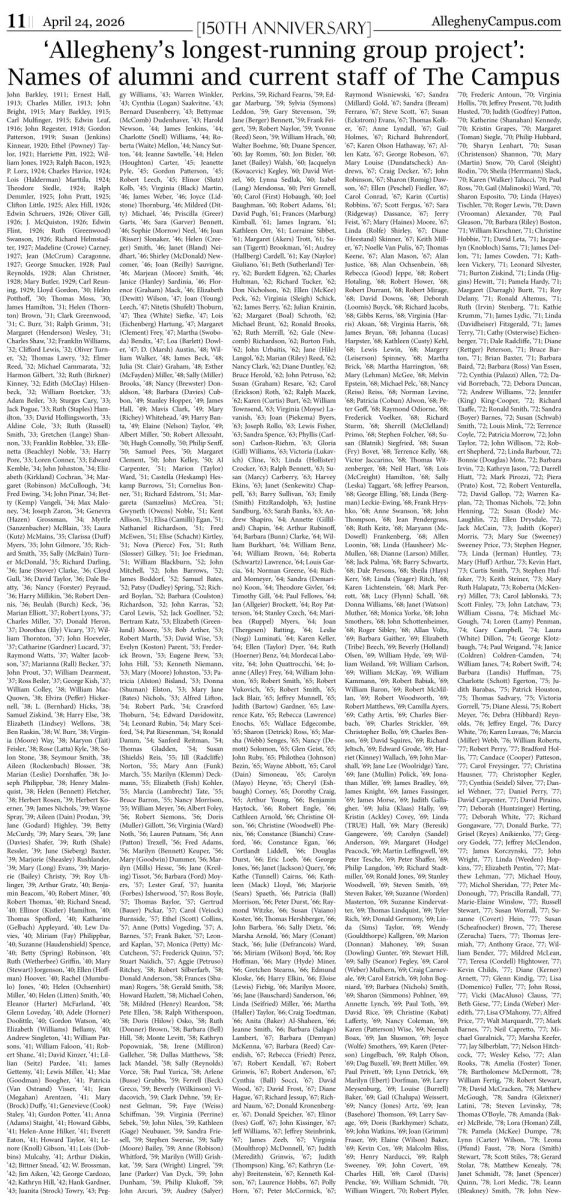
“This is the longest running Allegheny group project,” Westbrook said, “and it’s included literally thousands of alumni.”
Patrick Houston, ’75, was the first to jump on the question, stressing the importance of providing “intellectual honesty.”
“I think that’s one of the things I got from not only The Campus but most especially from Allegheny is a sense of intellectual honesty,” Houston said. “A way to deal with people and to be fair and to be reasoned and civil.”
Bywater said that he found the opportunity to work for The Campus to be a great gateway to life after Allegheny.
“If you want to do this journalism stuff, this is as real as it gets before it’s actually real,” Bywater said. “I mean, it’s a working lab. You can learn everything you need to do a journalist’s job by getting involved in The Campus.”
Switzer agreed, stressing the fact that reporting for The Campus is difficult, just like professional journalism.
“When I walked in my first campus meeting the advisor at the time looked up at me, and I said ‘I’m here to write,’ and he goes, ‘Great, more meat for the grinder,’” Switzer said. “We’ve all been through the same grinder, which is amazing.”
Cairns said the environment was similar during her time with the newspaper. “
There’s a certain spirit about The Campus that is going through it all,” Cairns said. “People are doing it because they love it. They don’t get any credit and it’s extra work, it’s a lot of work.”
Switzer added that writing for The Campus is a great opportunity because it is singularly focused on its reporting.
“This is real journalism, in some cases, it’s pure,” Switzer said. “Once you get into a media job you suddenly have to worry about classified revenue and private equity takeovers.”
In total, nearly 50 people attended the virtual panel online and at the viewing party in the Henderson Campus Center.
Throughout the call, messages could be seen on screen as alumni of the college traded stories about their times on the staff.
A recording of the virtual panel can be accessed on The Campus OutLoud!, the YouTube channel for The Campus.
Upcoming 150th anniversary programming includes an all-campus reception and anniversary program that will be held in the Tippie Alumni Center on Feb. 26, from 5 p.m. to 7 p.m. The keynote speaker will be Anne Rumsey Gearan, ’85, a former White House correspondent for The Washington Post, as well as an on-air contributor for NBC News and MSNBC. Following her address, there will be a panel consisting of Westbrook, faculty advisor for The Campus Mike Crowley, National Public Radio editor Chris Potter, ’93, and Professor Emeritus Ben Slote. Alumni, friends of The Campus and current students are encouraged to attend. Non-student visitors should register on The Campus’ website.
Later this semester, a reception and screening of a student-produced documentary about The Campus will be held in the late spring and over Reunion Weekend, which takes place May 29 through May 31. The weekend will also feature a Newsroom Open House, The Campus Alumni Panel, archival displays and a limited-release special reunion edition of The Campus.
This article has been updated to correctly identify Michael Crowley as a lecturer in the Department of Communication, Media and Performance. Updated: Feb. 6, 2026, 1:46 p.m.