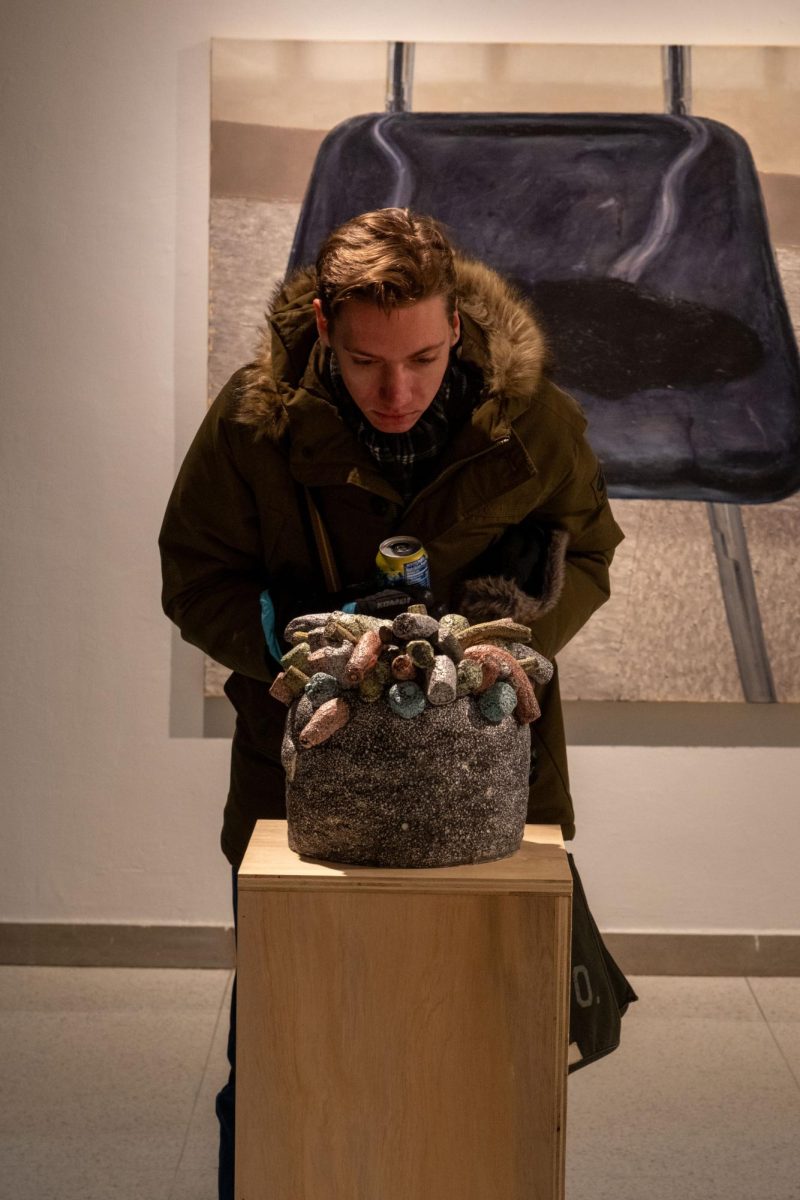
The Allegheny Art Galleries opened its doors for a faculty art exhibit on Tuesday, Feb. 3. The exhibit showcased works from three art department faculty members. Rather than focusing on one central theme, each artist focused on a different medium for their work.
Associate Professor of Art Heather Brand chose photography, presenting photos from three different series. One set of photographs, titled “Under Glass, Over Time,” is a collection of three digital photographs, looking up through foliage towards the sky, taken at Phipps Conservatory and Botanical Gardens in Pittsburgh. Another series, “Recursive Light,” was Brand’s favorite because she saw it as a return to form. “Recursive Light” is a collection of nine inkjet prints of different trees, taken at Brand’s home in Meadville, with polaroid transfers of windows placed on top.
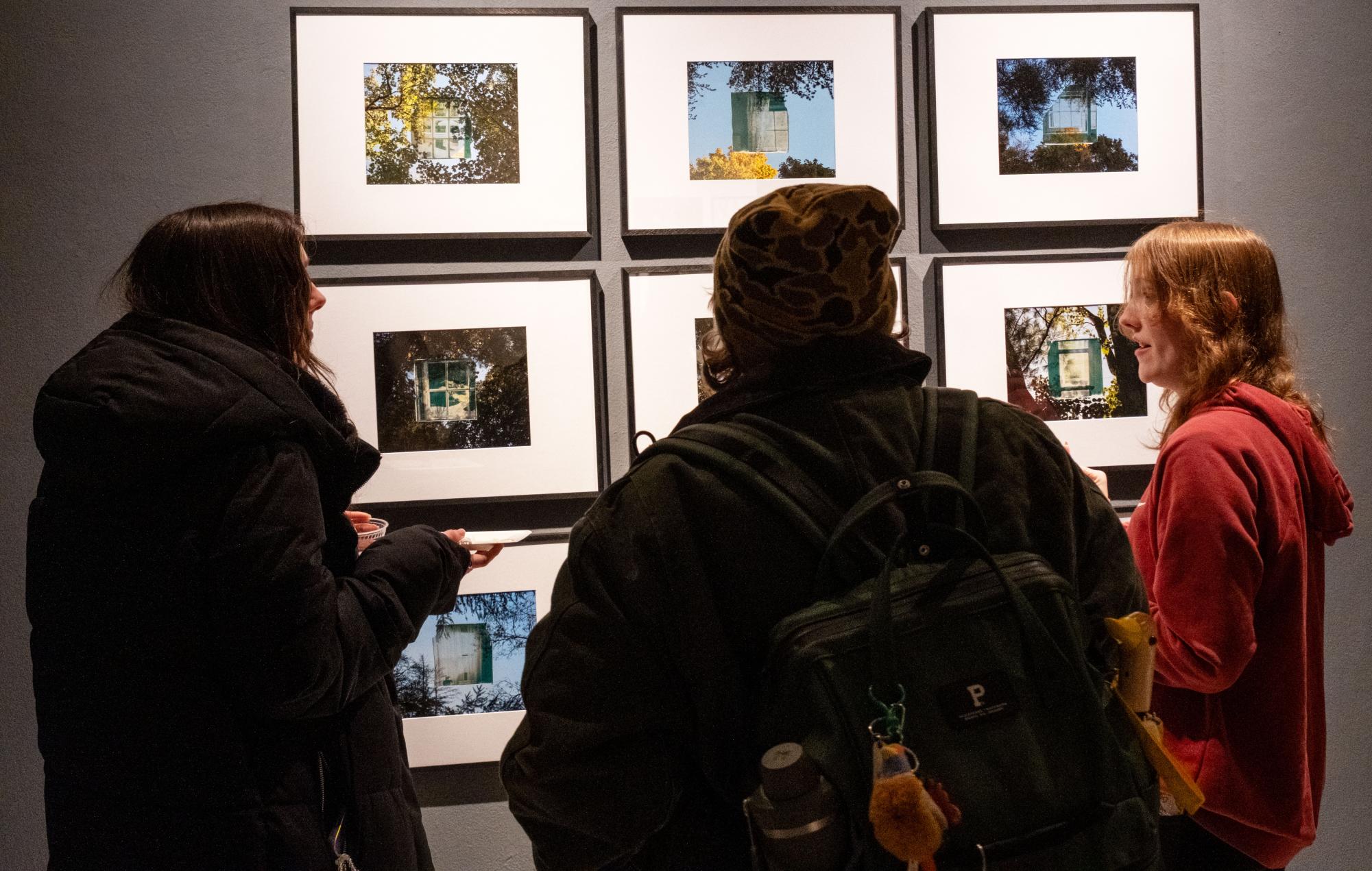
“It feels a bit more intimate because of the scale,” Brand said. “I had gone through a period of increasing the scale of my work, from like 8 inches by 10 inches, 16 inches by 20 inches then eventually to 50 inches by 33 inches. And then I kind of went in the opposite way now, and went to like, little polaroids inside of 8 inches by 10 inches, inkjet prints. And so it feels like kind of a rewarding return after that.”
Another series from Brand featured in the gallery is her series “After Utopia,” a group of 11 digital photographs taken at the Oracle, Arizona Biosphere as part of a faculty research project during her sabbatical during the fall 2025 semester, funded by the Allegheny College Academic Support Committee. The photographs were taken both inside and outside of the biosphere, focusing on the juxtaposition of architecture and verdure. Brand said her work highlights places of display, such as a museum, and feels inspired by the edges of these places.
“They’re interested in this idea of a world within a world,” Brand said. “The ending of ‘The Truman Show,’ you know, and he’s like, there’s something more beyond the sort of edges. And I think that my work in general is about that, and so, I don’t know, I just like this return back to something that feels more, like, a little subtle and hyper specific at the same time.”
Associate Professor of Art Clare Kambhu went a different direction with the work she displayed at the faculty art exhibit, presenting a collection of oil paintings inspired by her time teaching in the New York City public school system. The oil paintings are all still lifes based on the classroom she worked in. Kambhu said she would often paint right at her desk.
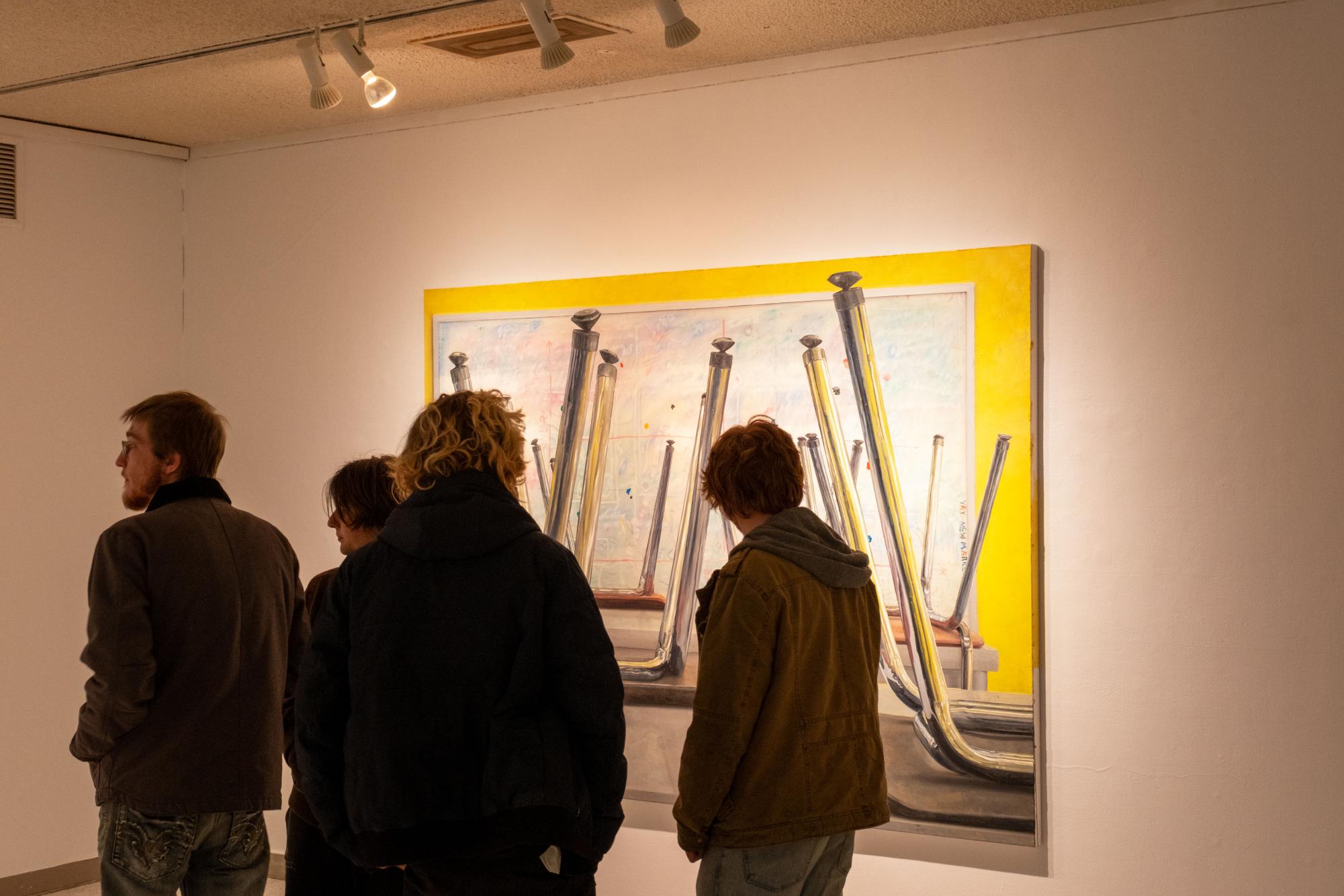
“That series of work began when I was thinking about education and the spaces that we inhabit as we try to develop as people,” Kambhu said. “Thinking about that developed as I was teaching in the public schools. I was thinking about how to make these places feel like they have human presence to them without depicting any specific people. Because, you know, schools are designed to accommodate everyone, but in doing so, they become very impersonal, and trying to inject some of the human touch through my use of paint and the thickness of the paint and the mark making.”
Kambhu said her painting “Permission Code” was her favorite piece in the gallery, but remarked it was hard to pick a favorite. “Permission Code” depicts the bottom of a whiteboard in a classroom, with a torn piece of yellow paper hanging off of it and a few wires along the floor. She chose it as her favorite piece because she finds it more abstract and strange compared to her other works. She also said that her two largest pieces, “Chairs Up” and “RULER Recognizing Understanding Labeling Expressing Regulating,” were also in consideration for her favorite, primarily due to the scale of the pieces.
While none of her pieces were made for this exhibition in particular, some pieces were created for a previous exhibition.
“They were shown in this exhibition at Garner Arts Center, which is in upstate New York,” Kambhu said. “And some of them were made for this, but some of them were even made before this.”
She hopes to continue her work in the future.
“My ongoing body of work is within this realm,” Kambhu said “I guess as an artist, it’s — rather than having, like, one research project and then moving on to the next project, we tend to work in across time and investigating a thing over many, many years.”
In contrast with Brand’s and Kambhu’s work, Art Technician Kate Sutter, ’20, showed off a collection of three-dimensional media, presenting 11 different ceramic sculptures, each titled “Poof Study” along with a number designating the piece. All of the pieces were made with ceramic foam, a clay body that Sutter has been working with for the past six years. For the exhibition, Sutter used a recipe for the ceramic foam she created herself, with the pieces serving as a sort of personal research project.
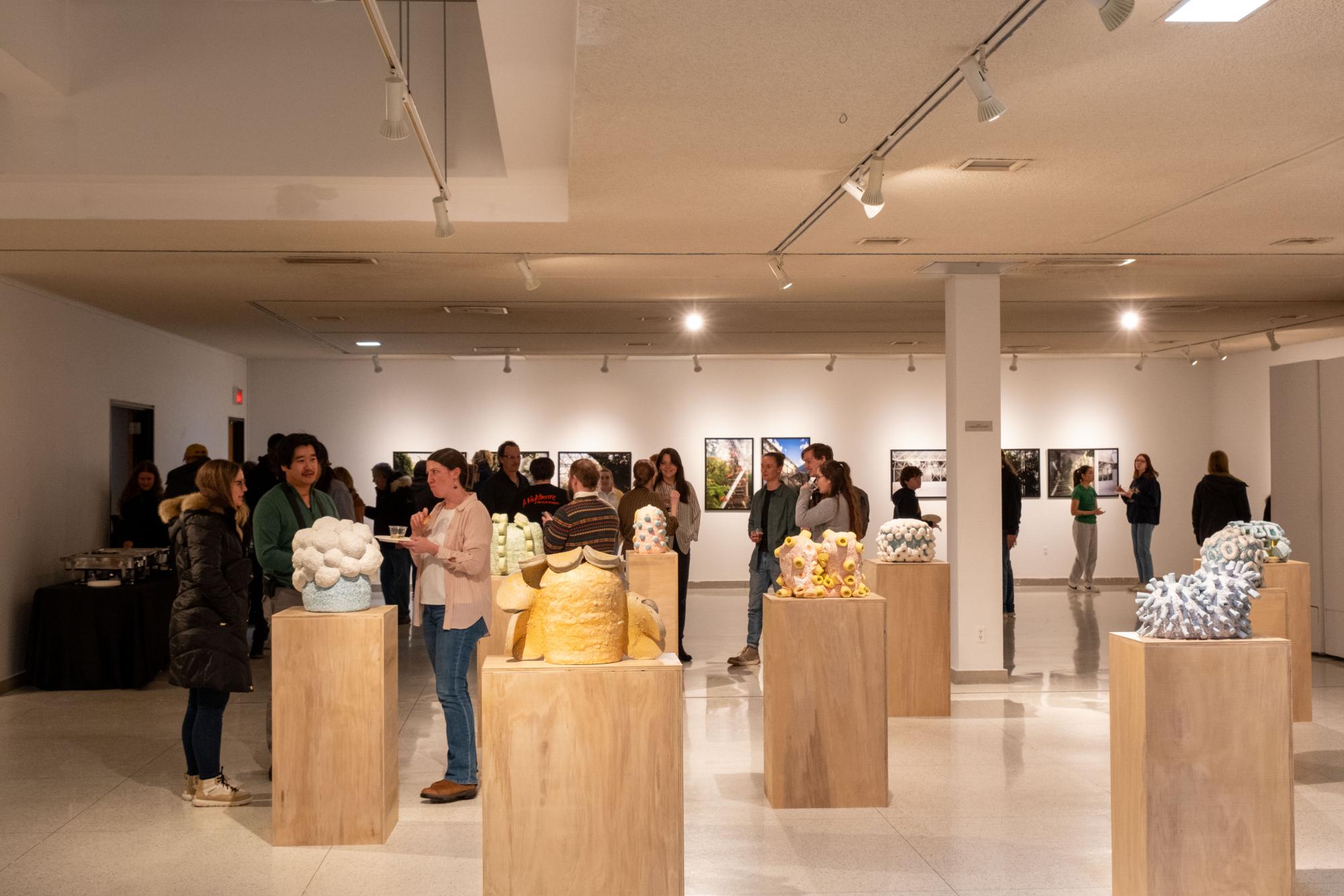
“There’s, like, a material study in a sense of what kind of attachments can I add on and how are they going to react when in the kiln,” Sutter said. “So when it goes into the kiln, it can expand up to like 4% to 500% depending on how I fire it. So a lot of it is just playing around with different fires and temperatures and learning when to remove them.”
Sutter studied not just how ceramic foam serves as a base, but also how she could add additional ceramic foam attachments to her pieces. These attachments range a variety of shapes, such as petal-like rounds, marshmallow-like puffs or cylindrical extrusions. Additionally, on many pieces some of these attachments have ripped, shifted their location or fallen right off.
“They were all attached going into the kiln and then depending on how well I attached them before, or how hot I fired at, some of them started to like drip and fall,” Sutter said. “It’s a just, like, a balance between looking in the kiln to watch how much has it expanded, is this the amount of, like, lean I want the piece to have?”
Sutter said that “Poof Study no. 22” was her favorite piece. The poof has a green cylinder base with two parallel rows of half-circles along the sides of the piece.
The faculty art exhibit will remain open until Wednesday, Feb. 25.