Only 9% of plastics get recycled. This was the reality shared by Director of Sustainability Kelly Boulton, ’02, and Assistant Professor of Environmental Science & Sustainability Kevin Geyer after The Playshop Theatre’s “The Time Is Now” production. The production was part of Climate Change Theatre Action, a worldwide festival of short plays about climate change that aims to bring the community together and encourage people to take action locally and globally.
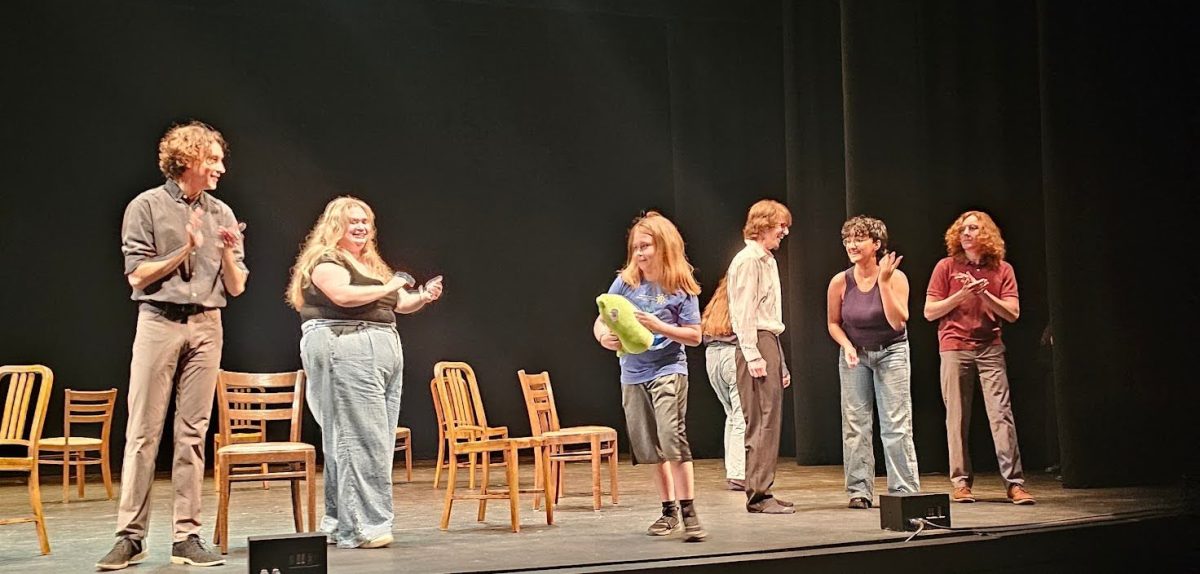
The production featured 10 unique plays, five of which were performed on Sept. 19, and the other five on Sept. 20. The celebration happens every other year, and this is the fourth time Allegheny College has celebrated CCTA.
Sam Kagle, ’28, a student who acted in “The Time Is Now,” performed in two plays in the Friday program titled “Earth Duet” and “Space Cat.”
“‘The Time Is Now’ is about how various people deal with the ongoing and increasingly important issues of climate change,” Kagle said. “Thinking about the possibility of where it could take us, some plays focused on people living at times similar to ours, and others are projections of worst-case scenarios, so it’s a lot about the present and also about the future.”
“The Time Is Now” was directed by Professor of Theatre Michael Mehler, who also runs the theatre design program. As the director, Mehler worked with the student performers through rehearsals and aimed to design a sustainable production.
“I started to think about design and production work — like the making of scenery, how we do lighting and how we make costumes — more sustainably,” Mehler said. “I try to do that with every play that I do, no matter what its themes or ideas are.”
CCTA provides new written plays every year to ensure the lesson of the play is relevant to what is happening to the environment.
“We’re thinking about issues that occur within the last ten years,” Mehler said. “We’re thinking about the issues that matter now, like microplastics, the issue of thinking about the planet that we got and how are we going to try and solve things.”
The CCTA’s deeply rooted themes of climate change taught audience members like Melinda Mulligan, ’26, who attended the Friday program, and Daniel Servey, ’29, and Victoria Smith, ’23, who attended the Saturday program, new things about the environment.
“The biggest takeaway that I learned was how valuable the Earth is,” Mulligan said. “The ups and downs in ‘Laila Pines for the Wolf,’ seeing people kill each other with guns, there is this build-up until the very ending of the program. In the ‘We’re Running out of Chairs’ play, seeing people play musical chairs was a sort of a release.”
“We’re Running Out of Chairs” is a play where the cast and selected audience members play a game of musical chairs, and a moderator, Nickel Spartz, ’26, talks about the behaviors of companies that do not want to mitigate their carbon emissions. After a winner is declared, all the chairs are returned to the circle to symbolize that everyone can have a seat at the table if some changes are made.
“I appreciate that, unlike most climate change messaging I see, which is you being responsible for the change and you being responsible to fix it — there are issues that we do, but we are not alone in this fight,” Servey said.
Smith appreciated the diverse content of the plays.
“I really liked the variety of the plays because I felt like they each talked about their own specific issue on climate change,” Smith said. “I feel like I was able to get a taste of different subsections of climate change giving me the opportunity to decide which one I want to research more.”
Student actors Rebecca Moore, ’28, Megan Kromer, ’28, and Aaron Rape, ’28, enjoyed stepping into their roles in “The Time Is Now,” even though they only had 16 days of rehearsal. They said their roles were important to them because of the fun that they had, the relation of their characters to their personal lives and how their roles pushed them.
Moore acted in “So This is the Last Apple Pie,” a play about a mother and a daughter dealing with the loss of their family farm and the disappearance of a bird species while sharing an apple pie made from their grandma’s orchard.
“My family has roots in farming, and my aunt is an amazing cook, and I love her pies,” Moore said. “The role made me happy because it made me think a lot about my aunt. Family traditions are just as important as the people you are sharing them with. For a lot of people, that tradition is cooking, and so to do that, you need the plants, the vegetables and you need the apple orchards to exist.”
Kromer acted in “Laila Pines for the Wolf” as the grandma, a satirical adaptation of Little Red Riding Hood. The wolf in this story, Jude Gotschall, ’26, is trying to warn Laila, Amelia Connick, ’29, to not pick the flowers because of the dangerous impact on the environment. Laila ignores the wolf, which leads to bad consequences for both of them.
“My role as the grandma was really fun and averts the audience’s expectations, and I come out with a pink gun and the first thing I do is shoot the wolf,” Kromer said. “I totally felt it was a satirical role. A lot of this stuff can be really down in the dumps, so I think it’s good to have that comedy.”
Mehler was glad the actors enjoyed their roles.
“I try to push them to do something they are not comfortable doing because I think that is a great way to grow,” Mehler said. “I like watching students gain confidence; getting that applause from the audience absolutely matters. Helping someone build that capacity hopefully gives them confidence to engage in a lot of other spheres of being.”
Mulligan was pleasantly surprised by the quality of the performance.
“My initial expectations were that it was going to be a little bit boring, like a high school-level performance. I literally cried during the ‘Space Cat’ play,” Mulligan said. “It definitely brought up a question in my personal life. I bought a trash can made of plastic, and I use a Q-tip made of plastic, so the plays had an alteration on my perspective on these little individual things.”
Smith said moving the audience like this is a goal of theatre.
“I think theater has a really great strength because it’s live and you’re there, so it changes the way you take things in,” Smith said. “It’s easy to distance yourself from media and television because there is a screen in front of you, but in the theatre it’s a purposeful choice to sit down and listen. I hope that the audience has that connection when they’re walking away and feel like there’s something else to do.”
A bonus play was included and performed in both programs called the “Bottle Dance,” which was created, choreographed and performed by Doug Lodge, ’75. The play was about a man in a suit and a rainbow umbrella hat stepping out onto the stage to kick bottles before realizing he had a thread of bottles behind him. He “danced” doing circles so that the bottles twisted around him.
“I am trying to convince people not to use plastic water bottles,” Lodge said. “If there were eco students here, it would be about changing policy. It’s about engaging people and thinking beyond your life and getting them involved in something that’s going to help make a change.”
Mulligan appreciated Lodge’s contribution to the production.
“It was so fascinating to me, without any words and just a violin, he could make something so memorable with his movement and something so visual,” Mulligan said. “Seeing him as like a plastic bottle monster shuffling towards the end of the play and then falling over, that was crazy to me, and I am definitely going to think about that demon hunting my memory every time I go to use single-use plastics.”